Showing posts with label Chuseok. Show all posts

Saturday, 3 March 2012

Five Days in Beijing: Part 6 - Chairman Mao and Yonghegong Lama Temple

We got up pretty early on our last day in Beijing to try to fit as much as we could in before our evening flight. We started off the day with a long subway ride to the far flung reaches of outer Beijing as I wanted to do a little camera lens shopping. Electronic goods are seriously overpriced in Korea due to the extortionate import tax they slap on everything non Korean and even domestic goods are more expensive than they would be in the UK or America as there isn't so much competition due to the import tax. So buying camera equipment can be pricey here (unless you buy "grey market" goods) and prices in China looked pretty tempting. 


We travelled out to the outer ring of Beijing city to go to an electronics market there. I was still feeling rather sick from my food poisoning but that didn't manage to dampen my zeal or buying camera stuff. I ended up with a new macro lens at a much cheaper price than I could have got it for in South Korea so I was pretty pleased. One of the weird things we noticed in this part of Beijing well away from the tourist areas was the throat tickling smog. The pollution really was noticeably worse and we were very glad when we got back on the subway and escaped to the more tourist friendly cleaner air of the old city. 


Canon EF 100mm f/2.8 Macro USM Lens for Canon SLR Cameras

Thursday, 1 March 2012

Five Days in Beijing: Part 5 - The Great Wall of China

We woke up pretty early on our third full day in Beijing ready for our tour to the Great Wall of China. We had heard that is was possible to visit the Wall yourself by taking public transport or by hiring a drive but that could be fiddly and confusing. As we only had a short amount of time in Beijing we opted for the tour so we could make the most of our 5 days. 


There are several different parts of the Walk that are accessible from Beijing. The most well visited part is Badaling, 50 miles northwest of Beijing City. We decided not to go there though as we had heard that it was a total tourist trap that would be heaving with tourists and people trying to sell tacky souvenirs and that the Wall there was so heavily restored it looked virtually brand new. Instead we went to the Wall at Mutianyu, 70km northeast of Beijing. This part of the Wall was older than the Badaling section and not s heavily visited for some reason.


The Great Wall at Mutianyu (care of Wikipedia - it was really misty when we went so none of my pictures were this clear!)

Wednesday, 29 February 2012

Five Days in Beijing: Part 4 - Summer Palace and Tea House Performance

We awoke to very misty weather on our second full day in Beijing. Despite the mist, we decided that we would head to the UNESCO listed Summer Palace. The Summer Palace was first built in 1750 and is a collection of halls, pavilions and temples gathered around a large man-made lake called Kunming Lake. The ground are dominated by Longevity Hill, which is more than 60 metres high and which was made from all the earth that was excavated to make the lake. The palace is popular with tourists but is also a public recreational park so there were plenty of ordinary Beijing citizens there enjoying the sights. 

Decorative gate (known as a 'paifang') at the entrance to the main Summer Palace grounds.

Tuesday, 28 February 2012

Five Days in Beijing: Part 3 - Forbidden City and Exotic Food Market

After a morning of trekking around the Panjiayuan Antiques Market and a brief visit to Tianamen Square we found ourselves in front of the Forbidden City and decided that we should go in and see what all the fuss was about. 


The Forbidden City, viewed from Jingshan Hill to the north. (photo care of Wikipedia)

Sunday, 26 February 2012

Five Days in Beijing: Part 2 - Panjiayuan Antiques Market and Tiananmen Square

We made an early start on our first full day in Beijing. The weather was vastly improved, warm and sunny an our plan was to do some serious sightseeing! We jumped on the subway and travelled to East Beijing for our first stop of the day, Panjiayuan Antiques Market. This popular flea market, also known as 'Dirt Market' apparently, has been going strong since 1992 and receives thousands of visitors every day, both locals and tourists. It's the place to go if you're looking for souvenirs and there are even some genuine antiques mixed in with the fakes and reproductions too! 

Panjiayuan Antiques Market on a busy Sunday morning.

Monday, 20 February 2012

Five Days in Beijing: Part 1 - Hutongs and decadent beer

So way back in the first half of September 2011, we were packing our bags once again to go on another quick overseas jaunt. It was the Chuseok vacation, Korea's Thanksgiving/Harvest festival style holiday and we had Monday - Wednesday off work. Koreans usually visit their relatives in their home-towns during this or ancestors nearby to visit we decided to take our 5 days of freedom and go explore another country. Last year we visited Japan for Chuseok, this year we decided it was time to go check out China, specifically Beijing. 

As usual, all the prices for travel were hiked up for the festive season and plane and train tickets were sold out way in advance. Travelling during Chuseok is like travelling during Christmas back home and can be a real nightmare if you don't plan it well. But as this was our second year of Chuseok madness we knew what to expect. 

The two faces of the Korean Chuseok holiday - 1. Songpyeon. They are rice cake dumplings filled with honey or beans and steamed with pine needles to add a nice scent that are traditionally eaten during Chuseok. (photo from http://parsonsesl3.wordpress.com/)

Wednesday, 13 October 2010

Japan! Part 3 - Mount Aso Volcano and Kumamoto

Our second day in Japan was also our first ever trip to an active volcano! Mount Aso is the world's largest active volcanic caldera at some 25 km across, unfortunately it is a pretty long journey from Fukuoka so we had to start early. We got up at 6:15am to catch the 7:07am express to Kumamoto and arrived there with just 13 minutes to connect with one of the four daily fast trains to Aso. The views from the train to Aso were quite literally breathtaking, mountains, rice paddies, bamboo forests, wind turbines all sorts! It was also one of the steepest train rides I've ever taken, the train track went through a series of switchbacks where it reversed direction to climb up the side of the caldera wall.

The drivers cab was open to the rest of the train so we could get right to the front and get pictures out of the front window (the driver was at the other end at this point, he hadn't left us to drive the train!).

End of the line! Luckily the train stopped here and changed direction on one of the many switchbacks we took.

One of the many jaw dropping views from the train window. In the distance you can just make out steam from a hot spring.

Rice paddies and mountains from the train window, again you can see steam from hot springs in the distance.

It is hard to get across just how massive the Aso caldera is, it has train stations, roads, a city and several villages all within it, luckily the eruptions which created the crater ended around 90 000 years ago and the current eruptions are limited to a few smaller cones in the centre including Naka Dake, the one we visited. I was stupidly excited about seeing an active volcano but also a little worried, in 1958 an unexpected eruption killed 12 onlookers and in 1979 a further 3 were killed by an eruption which destroyed a cable car system in an area that was supposed to be safe!

When we finally arrived at Aso train station around 11:30am we still had a 40 minute bus journey to the cable car station which led to the active crater, you see now why we set off so early? The coach delivered us to the bottom of the cable car and as soon as we got off we were hit by the stink of rotten eggs from the hydrogen sulfide coming out of the crater. We took the cable car to the the peak, which cost 1000 yen. It was a short ride up a not very steep few hundred meters and if we'd realised that there was a road which led on right up to the crater we would probably just have walked. By the time we arrived at the peak the stink of sulfur was overpowering and it wasn't exactly reassuring to discover the gas level warning was at the highest level, 5 ppm, which the sign told us were dangerous levels! People with asthma or heart conditions were not allowed up due to the high levels of corrosive gas in the air and there were signs advising people to hold wet cloths or towels over their mouths if they suffered any difficulties breathing while viewing the crater.

The view when we got off the coach, It had really started stinking by this point.

Cable cars taking people up the hill, we felt right at home in ours because it was full of pushy Korean tourists.

View back down the hill from the top cable car station, note the road on the left which also leads to the summit.

The gas level warning sign, you can't see clearly here but you'll have to take my word for it that the red light was flashing.

When we arrived at the summit the two closest observation areas were closed but the third one was open so we took a stroll up towards it while wondering if the massive clouds of gas blowing directly towards us we anything to worry about. We got about halfway up to the observation post when a siren sounded and an announcement ordered everyone to leave the viewing area immediately. Guides holding cloths over their faces came along hurrying everyone back towards the cable car, all very dramatic! We staggered away coughing and choking back to the cable car station and the gas levels were still safe there so we hung around for a while to see if the viewing area would open again. After waiting twenty minutes or so we decided to take a stroll around the still accessible area to the side of the crater.

The view from halfway to the observation post, just before the siren started sounding, note the gas coming straight towards us.

The shelters are provided to keep people safe in the event of an eruption, or at least to get them to gather together and make the body count easier.

Old guy selling sulfur from his van, I'm not really sure what you were supposed to do with it.

Smoke and gas rising from the crater.

Lava cliffs just to the side of the crater, they formed a valley which led down towards the crater, but we weren't allowed to go down there.

The view out over the lava flows to the side that was still open. The landscape was like I imagine the surface of Mars to be.

Sophie posing with the cairn that we made, I wonder how long it will stay there for.

A couple of tourists admire the magnificent views from the summit of Naka Dake.

The road from the summit that we would have walked up if we'd known it was there!

We walked around the side of the volcano for a little while then came back to see if the viewing area had opened again, it hadn't, if anything the eruption and wind had got worse. So we hopped on the cable car and headed back down the hill. As it was a while until the next bus we decided to walk down from the cable car to the volcano museum. That was a mistake as it was further than it seemed and by the time we got there the bus was just about to arrive at the museum. We decided to skip the museum having seen the real thing and hurry back so we would have time to look around Kumamoto on the way back to Fukuoka.

A small but perfectly formed side vent on the edge of Naka Dake.

We passed the old cable car system destroyed in the 1979 eruption on our way back down.

Near the volcano museum there were some beautiful meadows where you could go horse riding and a series of lakes.

We arrived in Kumamoto around 3:30 pm so plenty of time to have a look around, our main interest in Kumamoto was the castle which is supposed to be one of the best in Japan. It was easy to find our way to the castle once we'd caught a bus into the centre, it is huge and dominates much of Kumamoto. Admission to the castle cost 500 yen and included a map which you could stamp at various gates to prove you'd been round. The grounds included some incredible massive camphor trees and beautiful wells and turrets. The centrepiece of the castle itself was the huge central tower which really took it out of us climbing to the top, the combination of a very early start and volcanic fumes hadn't done us any good at all. We eventually reached the top and were rewarded with some beautiful views out across Kumamoto and the surrounding countryside.

The huge central tower of Kumamoto castle dominated much of the city centre and as you can see it looks pretty spectacular.

The walls at the base of the castle looked pretty near impregnable, I certainly wouldn't have wanted to be attacking them.

The view from the top of the central tower to one of the outer turrets.

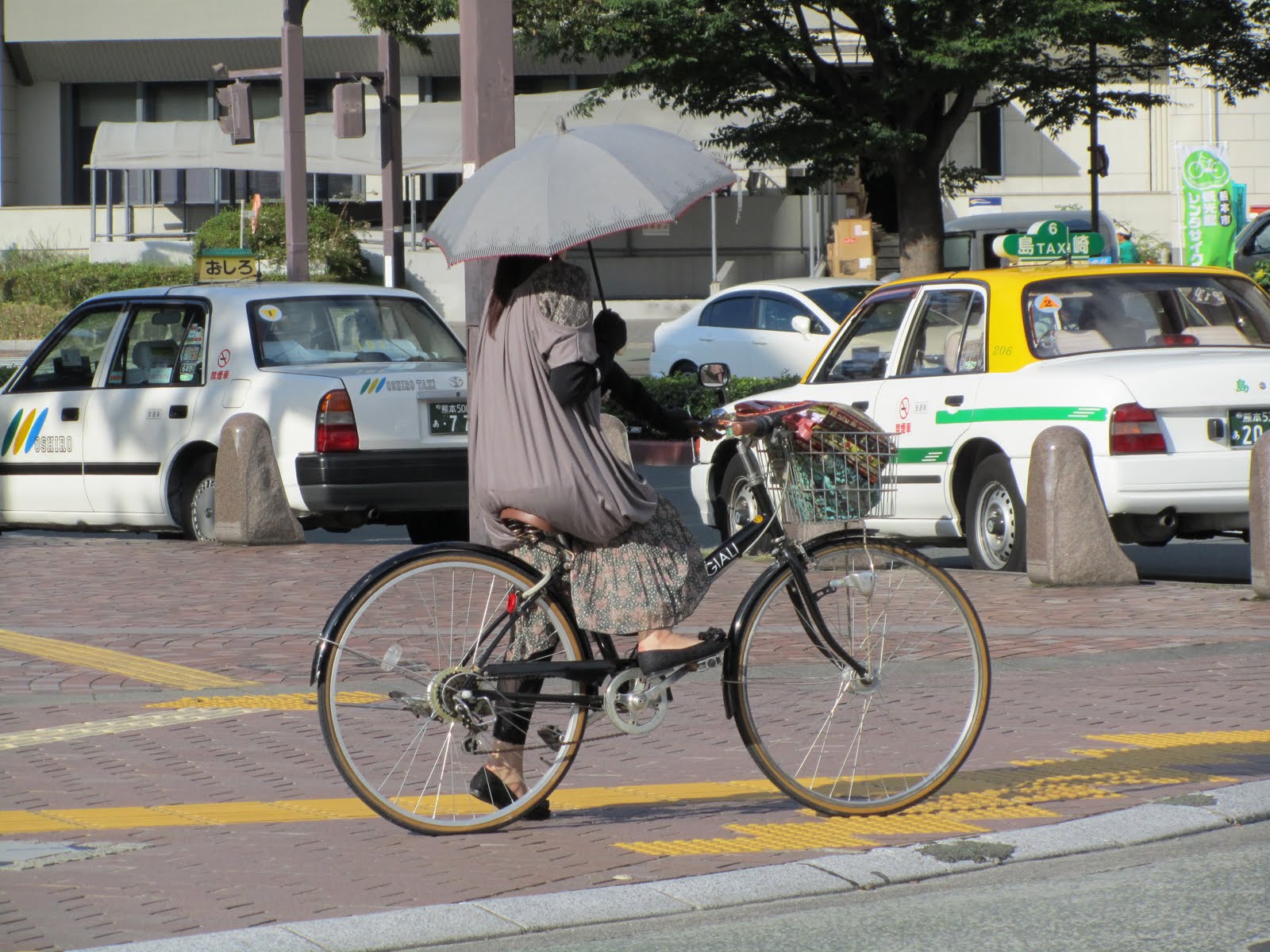
Kumamoto developed a special style of samurai swimming involving swimming upright in a suit of amour whilst firing arrows. In more recent times it seems similar skills have been applied to the art of riding a bicycle while holding a parasol.

We saw a real live ninja on our way to the castle, he posed for a photo and even took a photo of us. I guess he can't have been a proper ninja though or we would never have seen him.

After the castle we we feeling pretty hungry and alongside the castle Kumamoto is also famous for something else which I'd been advised by a Japanese friend of mine to try and that is raw horse meat! We went to a restaurant near the castle called Izakaya Yokobachi which was recommended by the guide book as a good place to try basashi or raw horse meat in other words. We got a bit of a shock when we saw the menu in the restaurant and realised that is was all in Japanese with no pictures! Fortunately a friendly waiter was able to help us out and we ordered the horse and a bowl of delicious ramen as insurance in case the horse wasn't good. The whole meal was delicious, the horse meat was melt in the mouth tender and delicious and the ramen was spicy and full of sesame flavour.

The restaurant we ate in was really stylish and had a lovely little courtyard where we ate and it was surprisingly cheap too.

Basashi! This was the raw horse meat and it was delicious, I'm never going to look at a horse in a field in quite the same way. It came with minced ginger and garlic to mix with soy sauce and use as a dip.

Delicious spicy, sesame and spring onion ramen.

After the delicious meal we got on the train back to Fukuoka, on the way back Sophie experienced the excitement of a high tech Japanese toilet which played the sound of the sea while you were using it so no one can hear any noise you make then flushed with you having to touch anything, exciting stuff! We took a bit of a walk around Fukuoka when we got back, played some Time Crisis at the Nameco arcade, did some research about Beppu for the next day then collapsed into bed knackered, it had been a long day!

Saturday, 9 October 2010

Japan! Part 2 - Nagasaki

We got up at 9am on our first morning in Japan and headed off to the train station. We had bought 3 day JR rail passes just for the northern Kyushu island area which allowed us to take pretty much any train we wanted except for the fastest bullet trains. However, there aren't any bullet train lines in that part of Japan so that was no hassle. The Japan Rail passes give foreigners a good deal on the price of rail travel which apparently is exorbitantly expensive usually. You can only buy the rail passes if you're in a country other than Japan and if you don't live in Japan though so it's no good for folk who live there. We caught an express train to Nagasaki and it looked pretty cool even though it wasn't a bullet train. We grabbed some breakfast from the station. I got some delicious bakery stuff that was filled with ham and cheese and unlike Korean 'bakeries' (Paris Baguette, Tous les Jours) the food actually seemed to be based on French cooking rather than being a bizarre assimilation (sugary garlic bread is a Korean bakery standard). Rowan got a bento box with rice, veg and a piece of salmon in it, a good cheap Japanese take out meal.

The express train to Nagasaki. It looked as cool on the inside as it did on the outside, with big comfy chairs and wooden floor boards.


Rowan's bento box. The strange looking vegetable is a lotus root.

The views from the train were lovely, rice paddies, small villages and rugged mountains . The colours were really vivid. We arrived in Nagasaki around 1pm and caught a tram to the Peace Park, a memorial park on the site where the second atomic bomb landed on 9 August 1945. Then we visited the Atomic Bomb Museum It was an interesting, thought provoking museum but of course it was extremely sad and some of the exhibits and photos were really painful to look at.

The simple black memorial plinth in the Peace Park. It was placed in the exact spot where the bomb exploded. The park was very peaceful, leafy and green. It was hard to connect this with the photos of devastation in the museum.

Part of the Urakami cathedral that was mostly destroyed in the explosion. This is one of the few remaining parts. At the time of the bombing it was the largest Catholic church in the East. Ironically, the US Air Force managed to score a near direct hit on the church, killing over 20 people who were gathered inside for a service.

Another memorial statue in the Peace Park, commemorating the 75,000 people who died in the atomic explosion.

A river running through the Peace Park. Scientists originally predicted that nothing would be able to grow here for at least 70 years so the Peace Park is really very special.

This lady was selling ice cream on the edge of the Peace Park, near a Nagasaki tow-path.

The light and airy atrium in the centre of the museum.

This clock is an exhibit in the museum. It's bent hands are stuck forever at 11.02am, the time when the bomb exploded over Nagasaki.

After the museum we caught a tram back to the train station and took a walk around some of the many temples in Nagasaki. There were too many to mention individually but they were all very beautiful.

Trams in Nagasaki.

Fukusai-ji Kannon temple is in the form of a huge turtle with a 18m high figure of the goddess Kannon standing on its back.

Close up of the Kannon goddess statue.

Rowan walking down Temple Row (Tera-Machi), a famous road filled with temples in Nagasaki.

One of the many temples on Tera-Machi.

Dragon detail from one of Nagasaki's temples.

A stone carving on the Tera-Machi.

These two funny little guys (note the giant balls) were outside a temple on Tera-Machi.


A Dutch house in Nagasaki. Nagasaki was one of the first cities in Japan to start trading with the West and there was a Dutch trading post in Nagasaki from the mid 17th century to 1855 that was the only point of contact between Japan and the rest of the world.

Rowan got this picture of crazy car parking Japanese style. Basically, you park your car on a metal platform and then it's rotated up and away like it's on a giant ferris wheel and is kept moving within the huge multi storey building, presumably until you want to get it back again.

After looking round the temple row we looped through the centre of town, past the harbour and then made our way back to the station. We picked up some delicious takoyaki (octopus balls) and ate them on the train back to Fukuoka. We wanted to get back to the hostel in good time as we planned to make a stupidly early start to get to Mount Aso, a huge volcanic crater that contains an active volcano, the next day. Unfortunately , this meant we didn't get to try any Nagasaki champon (the local ramen dish made with pork, octopus, squid, fish patties and vegetables) but I suppose you can't do everything!

Nagasaki harbour at sunset.