Thursday, 25 November 2010

School Sports Day

Feverish excitement gripped my school during October in the build up to 2 of the most important days in the school calendar: the school's sports day and the school festival. I don't remember anyone getting particularly excited about school sports day back in England when I was a kid and I'm pretty sure we didn't have a school festival day either so I was curious to say the least about what it would be like.

At break time, classrooms and corridors were filled with the sound of cheerleading as students prepared their chants ready to support their teams on sports day. They even made banners and cards to hold up when their classmates were competing in the different events, sometimes trying to do this surreptitiously during my English lessons in the mistaken belief that I - a) wouldn't notice and b) wouldn't mind - how wrong they were. Yes, this was a long way from the egg and spoon races that I remember from my childhood. It was more like the preparations for a major international sporting event (at least the kids seemed to hold it in a similar regard when I threatened to confiscate their banners if they kept messing around in my class). The build up to the school festival was even more impressive. One of the main components of the day was a pop song contest that was scheduled to make up the afternoon entertainment so for weeks the school rang with the sound of singing, dancing students getting ready for their moment of glory. There were even auditions being held for the honour of being able to perform at the festival which led to some of my students having to leave my class to attend their audition - it must have been a heartbreaking situation for them, having to choose between my English class and following their musical dreams! Unfortunately, in common with the UK, awful, wailing pop ballads are very much in favour here in South Korea, especially among students, so the singing in the corridors was of the ululating, throat vibrating variety which was pretty annoying. On the plus side, most Koreans seem to have really good singing voices - maybe it's all that karaoke they do! Another bonus of all this madness was that classes were cancelled for two whole days at my school - never a bad thing!


The students were all made to line up in the school playing field at the start of the day and salute the Korean flag as the Korean national anthem played on tinny speakers.

The first day was the school sports day. Unfortunately, this was the week when the weather suddenly turned really cold so I, like most of the teachers, spent a lot of time hiding in the library which was the only room that had any heating on at this point. I did manage to catch some of the "soccer" (football to us Brits) matches and a few of the races though. The supporters were out en masse. From what I could work out, each class from the 1st, 2nd and 3rd grades fielded teams and competitors for the different events and the groups of supporters were made up of the rest of the class. It was an interesting sight, as each class had their own specific costume, worn by supporters and competitors alike. Some of the best ones were the class that dressed up in witches hats and cloaks (it was close to Halloween time) and the class that all wore baggy leopard (cheetah?) print leggings with tails coming out the back of them.

The sports day kicked off (sorry) with a few football matches.

Loyal supporters braved the cold with the aid of blankets and banged their baseball “thunder sticks” (inflatable cheering balloons that get their name from the loud noise they make when you beat them together).

My school had it's very own MC for both the sports day and the school festival. The colourful 3rd grade English teacher sported a wacky bandanna and a mic and provided a running commentary for both days.

Competitors line up on their marks ready for a relay race. Note that one of the runners is wearing his class costume of leopard print leggings as are some of the supporters standing at the back.

Most of the kids really went for it in the relay races. There were some funny moments when runners crashed into each other at the changeover point of the race and it ended in a bit pile up of sprawling students and scattered batons.

I think this was class 1-10, clad in their Halloween supporters costumes, giving it their all in support of their relay team.

A photo finish for one of the 2nd grade boys. Note the leopard print leggings worn by supporters in the right hand corner of the picture.

I'm not sure who won the different categories but it was a pretty fun day. The next day was the School Festival, which was even more exciting, but I will write about that in another entry to save this one from getting too massive.

Wednesday, 10 November 2010

Daejeon Rock Festival

A few weeks back some friends we'd met and the GEPIK orientation told us about the Daejeon rock festival, apparently it would be a one night mini rock festival with 14 bands from around Korea, international food and beer and free entry! Having missed our usual summer dose of festival action in the UK (we normal work as festival stewards through the summer in the UK) we were very keen to go and check it out. So we hopped on the express bus from Gwangju to Daejeon its was a pretty quick journey at about 1 hour 40 minutes and we arrived at Daejeon bus terminal around 4:30pm looking forward to checking out the music and also the international beers.

We booked into a cheap motel near the bus terminal, one of the cheapest we've experienced;yet at only 20 000 won a night but it was nice enough, we've certainly stayed in worse places for 2 or 3 times the price.


Sophie checking out the facilities in our luxury 20 000 won room.

After dropping off our stuff we took a stroll into town just looking around and trying to work out where the festival was, after a little while of not seeing much but big roads and realising we had no idea at all which way it was to the festival we hailed a taxi to take us there.

We arrived at the festival site some time just before dark and found it was right next the the Daejeon balloon festival which was going on in the daytime, unfortunately we missed the balloons but there were still lots of airborne antics going on including a crane based hanglider wizzing round, a remote control blimp flying around and people flying past on fan powered parachute things.


The hot air balloons were on the ground by the time we arrived but the burners were still putting on a fiery display from the ground.

You can't see it very clearly from the photo but these were guys in parachutes with flares on their legs.


They came flying over the hot air balloon burners at a perilously low high, I'm surprised they didn't burn their toes.


There was a beautiful firework display over the river at the end of the show.

The fireworks were beautiful, unfortunately I had the camera on the wrong settings so they came out very blurred, still some of them created some interesting effects.

One of the main reasons we were interested in the Daejeon rock festival was because of the promise of international beer and food. The website promised 300 vendors selling international food beer and wines, so we rocked up eager to taste the foreign beer, unfortunately as often seems to be the case in Korea the enthusiasm of the advertising was not lived up to by the reality. Instead of the promised 300 stalls, there was one beer stall selling mostly a Korean domestic beer, they also had a choice of Hoegaarden, San Miguel, Heinekken or Guiness for about £5 a bottle, not quite the international quality beer selection we were hoping for!

While the beer and food selection wasn't great, there was a Chinese lamb kebab stall which was bloody delicious, so delicious we went there three times in the night.

The food and drink situation might not have been all we'd hoped but the bands were pretty cool, a good mix of styles and all with plenty of energy. Although I was a bit confused by on band whose drummer took a call on his mobile and dashed off stage mid-song!

The crowd and the main stage.

Our favourite band of the night had to be Ska Sucks! a Korean ska band with brilliant energy and stage presence. It was great hearing Koreans doing something other than K-pop.

The festival had been planned to run unitl 5am but around midnight, the police decided that it was too loud or didn't have the right permits or something like that and it had to be closed down. The shut down was a bit chaotic, we couldn't hear the annoucement from the stage but through word of mouth travelling through the crowd it seemed that they had been told they had to stop and the music would continue at local bars, but no one knew which ones. So went it all when quiet we ended up getting talking to a group of locals who were going to a bar called Yellow taxi. We followed them there and drank some more, once we were so drunk I could hardly see properly we decided it was about time to get some sleep so we eventually managed to direct a taxi back to our motel and passed out for the night. We had the mother of all hangovers the next day but luckily it was a short stumble across the road to the bus terminal on back onto  the bus to Gwangju. All in all it was a good night out and we had fun, they could do with sorting out some more internetional beer for next year though.

Monday, 25 October 2010

GEPIK Orientation October 2010

So almost 6 months into our year in Korea and it was time to go do some training. GEPIK (Gyeongi Education Program in Korea) Orientation is mandatory for all Native Speaker English Teachers in Gyeongi Province. It would have been more useful when we first arrived but we came at a weird time due to the teachers before us leaving early. The training was at a residential course for 3 days in some far flung corner of Gyeonggi province. We got paid our usual wage (i.e for working 8.30am to 4.30pm) for the time we were there and they put on a bus to get us down there which was nice because the training centre was miles from any kind of civilisation. We had an early start to go and catch our bus and made it to the bus with exactly one minute to spare before the advertised departure time. It turned out we needn't have bothered running though because the bus waited around for another ten minutes while the driver had a fag.

Before we arrived at the training we had contacted them to ask if we could be put in a room together since the rooms we were staying in were for two people and we came to Korea as a couple, applied for our jobs, as a couple and live together in the same apartment as a couple. However, we were told this wasn't possible as sleeping arrangements had to be split up by gender, no exceptions - who knows what we might get up to! No-one was able to give us a straight answer as to why this was the case. We were given at least 3 different reasons why we couldn't share a room including that it was against GEPIK rules, it was against the rules of the company that managed the facilities and also the classic 'it's against Confucianism'! It was only for a couple of nights but it was pretty annoying and we did kind of feel like they were treating us like children. Also, we only have one set of basic toiletries as we usually share accommodation so it made having a shower and brushing our teeth a bit of a pain in the neck! Our same gender room mates were cool though and we did our best not to be too pissed off about it despite the GEPIK staff being really pretty unhelpful about it all.


We arrived at the training facility and were immediately made to line up by gender to get our name badges and room keys. After dumping our stuff in our rooms we went to the rather chilly main hall to attend the opening ceremony. This started with us all being made to stand up and pay homage to the Korean flag whilst having the Korean national anthem blasted at us which was quite surreal. Then we were treated to a performance of Samul Nori, a traditional form of Korean percussion music that originated form farmers' folk music. The performance was really interesting and even included a bit of plate spinning!

Samul Nori performers at the opening ceremony of GEPIK Orientation.

Sanul Nori means "four objects" (samul) "play" (nori) because it is performed with four traditional Korean instruments including 2 drums and 2 gongs.

Plate spinning skillz!

After the long opening ceremony, we had lunch which was really not very appetising. They attempted to cook Western style food but failed miserably and it didn't help that the food was all cold as well. This was a real shame as the whole training facility was freezing and we'd really been looking forward to some hot food. The only decent meal we had at the training was bibimbap presumably because it is a Korean dish.

Our delicious welcome dinner. It consisted of cold spaghetti with tomato sauce (the only warm thing on the plate) freezing cold, lumpy, mashed potato and a cold burger in some kind of brown sauce. Mmmmmm!

Then we started on the first round of lectures on GEPIK, Korean culture, co-teaching and the Korean education system. Some of these lectures were useful but I have to say that most were not, partly because we had been here for 4 months already I guess. There was lots of talk about the differences between Western and Korean culture and their different styles of education. This would probably have been quite useful for the first time teacher fresh off the plane but for us and the majority of teachers who had been there for a month or more these lectures were a bit pointless. The bottom line seemed to be that whatever was asked of you, no matter how ridiculous, you should just accept it and do it because it was due to cultural differences and/or Confucianism! Also, some of the lectures didn't seem very well informed and some of the more experienced Native English teachers in attendance were actually correcting the information that lecturers were giving us which was a bit worrying. We did get shown a funny and informative video though about a (fictional?) English teacher called Mario and his experiences of cultural differences in Korea including the classic one where he tries to phone in sick with a heavy cold and his Korean co-teachers come to his house to take him to hospital. This point was used to explain to us that Koreans go to the hospital for much more minor things than people in the West do and that Koreans also don't really take time off sick unless they're completely incapacitated, things that we have already found to be true.

By far the best lecture we attended was one called classroom management by a guy called Tim Thompson. Unlike mots of the other lectures it was actually packed with really useful information and tips for teaching and he didn't feel the need to bellow at us in a patronising manner like some of the other speakers had. The points he made were really insightful and his teaching and discipline tips were really helpful. In fact, we have both started implementing some of his ideas in our classrooms now, particularly Rowan who has now split all his classes into teams to try to use competition and student's loyalty to one another as aids to discipline. I think he is having mixed success with this at the moment but he says that discipline is better than it had been before so that must be a good thing.

The Orientation schedule was actually quite long and demanding. They obviously didn't want us to have too much time to ourselves in case we got up to trouble (apparently in previous years GEPIK Orientation had been treated as a non stop drinking party by the English teachers so now we were paying the price with a midnight curfew, a no soju rule and with not being allowed off the training centre premises without a pass which no-one seemed able to get!) The training was for 3 days but we only really had lectures for the first 2days. The lectures went on until 6 pm on both days followed by dinner until 7pm and then on the first day there was an optional Korean language class for beginners or an optional lecture on how to jazz up PowerPoint presentations until 8.30pm. After all that, we had to prepare a demo lesson presentation with the person who had been assigned to us as our partner earlier in the day. Most of us met up with our partners in the computer room and had to fight to get a computer as there weren't enough computers for everybody to work on. Some people spent ages working on their presentation, making pretty PowerPoints and props and were still beavering away until 10.30pm. We were still working on ours until about 10pm so we were pretty knackered when we were finally able to enjoy some 'free time'. We had a pretty quiet night that first day and after just one beer we said goodbye to each other and went to our separate rooms on our separate floors. It was a very misty morning on day 2 so Rowan went for a wander and got some photos of the training centre's grounds in the mist, including the extremely high, vertigo inducing assault course.

GEPIK in the mist.

Part of the assault course in the mist.

An important message that everyone should pay attention to - this was pasted up on the wall outside the training centre.

We had another packed morning of Korean culture lectures and then in the afternoon it was time for us to do our demo lesson presentations. I did my presentation about the present and past tense and it seemed to go ok. Rowan and his partner Jeanette did a presentation called Costumes and Cultures and it was an absolute scream! It was an outrageous collection of bizarre national stereotypes including unlikely claims about how all Scottish people wear kilts, eat haggis and toss the caber and how Canadians wear lumberjack shirts and only eat maple syrup and pancakes. It included some ridiculous accents, impressions and various other silliness. Other people in our group said it reminded them of something out of Monty Python. They ended up being voted the best presentation which evidently irked the coordinators a bit as it possibly wasn't the most serious of the contributions so they decided to award a second prize to a team who hadn't taken such a comedic approach. Rowan was very proud of the GEPIK branded mug he won as a prize and used it to drink from for the rest of the training.

The training centre was surrounded by really pretty, peaceful countryside and was set in nice grounds too.

After dinner on the second day we were all amide to take part in some kind of bizarre mass games in the main auditorium. This hour of enforced fun was called Movin' and Groovin' and it was compulsory. We were all split into large random groups of which ours was the most unenthusiastic and each group was assigned a GEPIK coordinator. Our leader seemed to be as unenthusiastic as were were. We then had to make up some kind of cheerleading chant for our team using our coordinator's name. Ours was pretty lacklustre but some of the other teams really went to town and made a huge amount of noise. I think it didn't help that our group was right at the back of the auditorium so we couldn't really hear what was going on and what we were supposed to be doing. Then we played some team building games and had to do some silly dancing. This was quite amusing but seemed a little pointless seeing as we were all going home the next day. Team building games are surely better used as an ice breaker on the first day. I'm sure it would have been more fun if we had been allowed to have some beer whilst doing the games as well! One of the weirdest moments was when the GEPIK coordinators all had to get up on stage and have a dance off for points for their teams. Some of them seemed to really enjoy it and went for it but some just looked really embarrassed and I felt quite sorry for them.

Me and a couple of crazy girls we met on orientation amused ourselves in the auditorium by racing each other on our wheeled chairs. It was fun!

Everyone gathered for thye Movin' and Groovin' mass games.

After the mass games we were finally free to drink and make merry, though we were under strict instructions that if we wanted to take photos we shoiuld not put them up on Facebook etc. and tag them as GEPIK Orientation as the anti-English contingent in Korea would seize on it as proof that we hadn't actually been doing training but had just spent the 3 days partying at the Korean tax payers expense. This despite the long hours we put in and the fact that most of the people on the training did treat it seriously and did work hard and attend all the required lectures. It seems that there is a small but vocal section of Korean society who don't want us here and think that English education is a waste of money. They're welcome to their opinions of course but I'm not sure that GEPIK should be kow-towing to them really. Therefore, the following pictures do not contain any alcohol in them and merely demonstrate the fun we had that night making new friends and playing table tennis whilst of course remaining completely sober! (No we didn't buy and drink any of the beer on sale in the training facility's on-site shop - that would have been wrong.)

One of the many games of table tennis that we played on our last night at training. We played it using our hands instead of rackets and loads of us played at once. Once you took your turn you had to run to the side and the next person took their turn and so on until there were two left then they played a normal game.

I won a game of table tennis eventually so was allowed to wear the ping pong crown for one round. Notice that I'm holding a bottle of water in my hand as I'm a true sporting professional.

Some people got together at the end of the night for a bit of a sing-a-long but this was soon broken up and we were herded to our rooms - it was midnight after all and there was a risk we could all have turned into pumpkins.

It was a good way to end the Orientation and we had a really good night. I think we deserved it as well after all those lectures. On the third and last day, we handed our keys back in and had a meeting in the morning to go through the terms of our contract. This was actually pretty useful and allowed people the chance to ask questions about their contracts and get advice for any problems they were having. Then it was all back on the buses and we were back in Moran by midday, effectively giving us a half day off which was a nice bonus.


People are smiling because they're leaving and it's Friday and we have a half day off. Nice-uh!

Overall, I thought the training had it's good and bad points. I made some comments on the feedback form about how I thought the Orientation could be improved, such as by having more practical info for first time English teachers (e.g. how to set up a bank account and transfer money home, how the recycling and household rubbish rules work in Korea, how to pay bills etc.) as many people struggle with those things, less repetition on Korean culture as we kept getting told the same things over and over and more lesson planning help, maybe with some demonstrations of good lessons by experienced teachers. After all, most of us at the Orientation were first time teachers with little or no teaching experience and the things most people were worried about were things like classroom management, good English games and effective lesson planning. Still, we met some cool people who we have since met up with and the ping pong was fun!

Monday, 18 October 2010

Japan! Part 4 - Monkey Mountain and Beppu

We woke up on the last full day of our Japan vacation feeling very tired thanks to some drunk Americans who had woken us up at 4am shouting and banging about in the corridor outside their (and our) rooms. In fact, they were so loud that I'd assumed that it was 7 or 8am and it was time to get up as surely nobody would be so selfish and inconsiderate as to make that much of a row in a hostel where they shared the facilities with other travellers from all over the world would they? So, we were not at all impressed and had a bit of a crap start to the day. Still, we dragged ourselves up and caught the 9.20am Sonic Express train to Beppu, a city on east coast of Kyushu island. Yet again, the weather was warm and sunny and we passed through some really pretty countryside on our train journey

The Sonic Express was fast and smooth and really nice, with wooden floors and big comfy seats.

View of the Japanese countryside from the train window.

We pulled into Beppu around 11.20am and headed straight for tourist information to get some maps and a bus timetable. Beppu is a bit of a tourist town as it is known as Japan's onsen (hot spring) capital and according to Wikipedia " it has the second largest volume of hot water in the world after Yellowstone in the USA and has the largest number of hot spring sources in Japan". Beppu is literally drowning in hot springs so it is a good place to sample that favourite Japanese pastime the hot spring bath, hence the large numbers of tourists. Our first onsen experience was a public hand bath just outside the train station and the water was lovely and hot.

We decided to take a little side trip though before we explored Beppu's onsens. We had heard about a mountain near to Beppu called Takasakiyama that had a large population of Japanese macaque monkeys living on it so we attempted to go there. It should have been a 10 minute bus journey to get there. However, we must have caught the bus going in the wrong direction or something and what should have been a quick 10 min trip turned into over an hour long odyssey across 3 different buses and a lot of confusion! Never mind, it was worth it. I'd never seen monkeys living in the wild before so I was very excited about going to the monkey park. Takasakiyama (Mount Takasaki) is a forested mountain and home to more than 1500 wild Japanese monkeys. The monkeys are fed regularly by park wardens, apparently to keep them on the mountain and prevent conflicts with farmers and residents in the neighbourhood. We rode the monorail up through the gardens and found there were monkeys everywhere as we had arrived at feeding time. We had wondered if we would see any monkeys but we needn't have worried. They were climbing over everything and were busy grooming each other, playing and fighting. The fighting and screeching was a little unnerving actually. We got chatting to an American girl and as we were talking two scrapping monkeys came screaming past and one of them grabbed her leg. She shrieked and grabbed hold of me in terror which was embarrassing for her but pretty funny. I think if one of those monkeys had grabbed me I would have done the same thing - they looked cute and fluffy but their claws and teeth didn't and the older males were quite sizeable. Anyways, it was really interesting to see such a large group of monkeys interacting with each other and we got loads of nice photos of them too.

The monkey mountain monorail for lazy people like us that couldn't be bothered to walk.

These were two of the first monkeys we saw. They spent ages just grooming each other, picking out the fleas and yep, eating them!


This monkey was down on his luck and ended up in the gutter.


The guy in the yellow shirt is a staff member feeding the monkeys which is why they're all following him like the Pied Piper.


It was a pretty hot day so some of the monkeys were taking a bit of a dip.

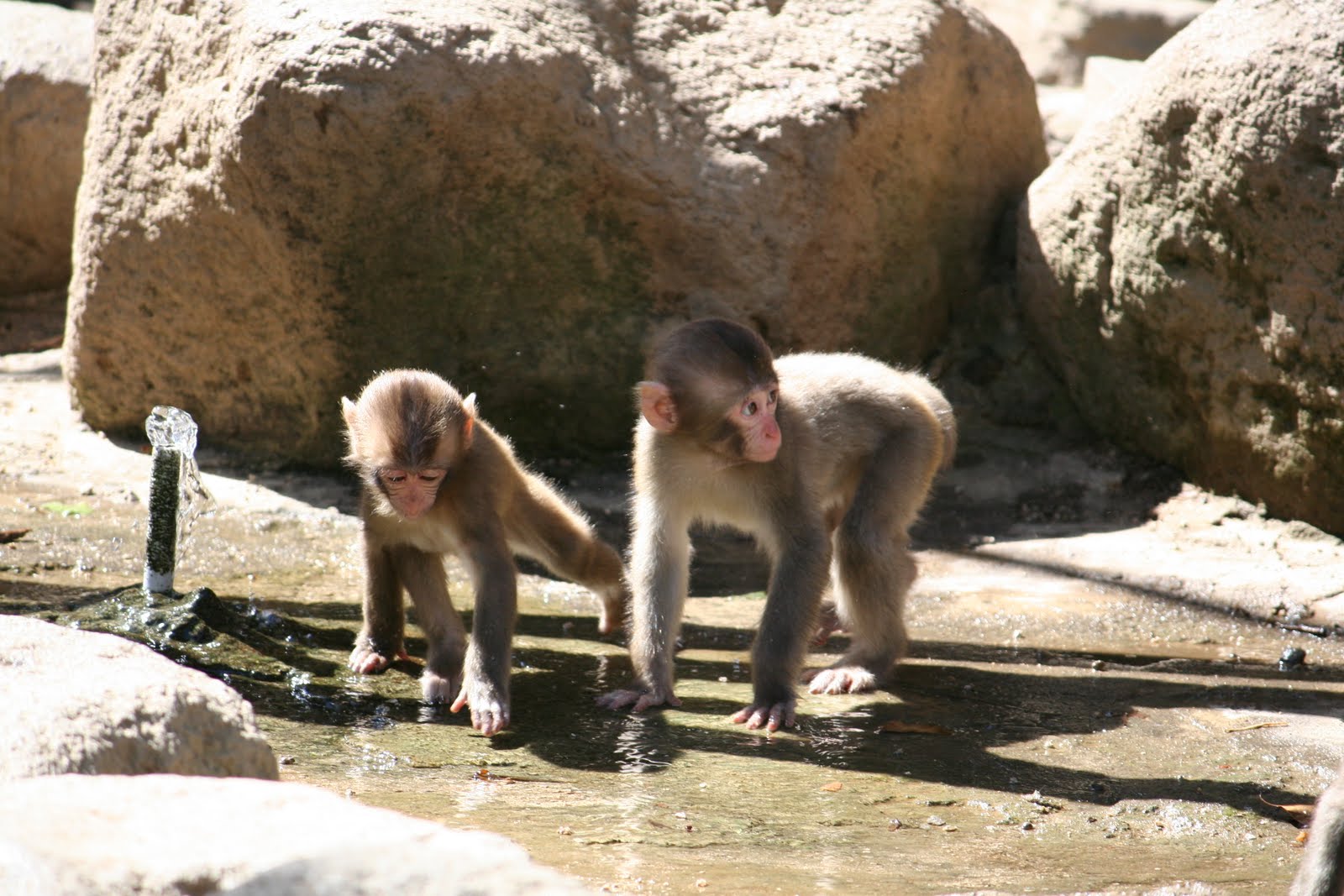
The cutest, cuddliest monkey baby ever - it would rip your face off given half a chance though!

Mum's stuck doing the school run again. Life's not easy, even for monkeys.

We finally got a shot of the giant black butterflies that we'd been seeing all round Korea this summer and here it is. This photo doesn't really show the scale of it but it was about the size of an outstretched adult hand i.e. pretty big!

Monkdonna and child.

Cute baby monkey perched on a sign.


Monkey puzzle tree!

After hanging out with the monkeys for a bit we caught a bus back to Beppu, picked up some bakery food for lunch and caught another bus along the coast to a popular beach-side sandbath where the guidebook said the staff spoke good English. It turned out the staff didn't speak a word of English so it was very confusing! After a while we worked out with the help of a young Japanese customer that we had to wait 30 mins for a sandbath but in the meantime we could sit out the back dipping our feet in a very hot foot bath overlooking the sea which was very relaxing. When our time came we went off to our separate changing rooms, and got changed into some loose fitting robes and made our way outside onto the beach. We were buried in shallow sand trenches by a small army of women armed with shovels. The sand was heated by the hot springs and we had little wood blocks to rest our heads on. The experience was pleasant if a little odd. It was a relaxing lying there facing the sea and hearing the lapping of the tide but it was kind of creepy being buried alive! After 20 mins we were allowed to lift ourselves out of the sand and we went off to our separate changing rooms again where we had a shower to get all the sand off, dumped our robes into a laundry chute and then went for a soak in the hot bath with a load of other naked people!


View of the coast from the beach behind the Sand Bath place.


Hot foot bath on the beach.


People getting buried in hot sand by ladies wielding shovels.

After getting dried off and dressed we got a bus up the hill to have a look at some of Beppu's nine 'hells' (geothermal hot spots). These were hot springs for looking at rather than bathing in and we saw two of them, a red one called Blood Hell and a blue one called Sea Hell. They were very steamy and they stank of sulphur, that eggy odour that we had already encountered at Mount Aso. They were boiling eggs in the Sea Hell though I can't imagine they tasted very nice given the smell wafting out of the spring! They both looked very impressive though.


There were so many hot springs in Beppu that there was even steam rising up from under the streets.

The Blood Hell is Japan's oldest hell and gets its colour from the red clay that it sits in.


The cobalt blue pool of boiling water called the Sea Hell is apparently 200m deep and emerged about 1200 years ago after a volcanic eruption.

After looking round the hells it was getting dark so we headed back to the station and caught a train back to Fukuoka. As it was our last night in Japan and we loved the food there so much we decided to go on food mission to try and sample a few of Japan's specialities while we had the chance. The first thing on our list was tempura so we went to a little place called West which had been recommended in the guidebook. The tempura was pretty nice but it was more of a greasy spoon cafe than the bustling, steamy ramen joint that the guidebook had promised. After that we did some more wandering the streets in pursuit of somewhere to get some o-tore sashimi (raw fatty tuna belly) but we couldn't find anywhere that served that so we settled on a place that had some normal tuna ngiri and had a few pieces of that along with some sake. We expected the sake to come in a small glass so we were pretty surprised when they brought out a jug of it for us to enjoy! I'm sorry to say that we ended up abandoning a fair bit of it, there was just too much. We did a bit more wandering but by about 1am we were knackered (it had been a hell of a long day) and a bit lost so we grabbed a taxi back to the hostel. It wasn't cheap! That taxi ride cost a fortune compared to what you would pay here in Korea but it did have seat belts and the driver was listening to jazz so I suppose you get what you pay for!

A plate of tasty tempura from West.


Rowan's tuna nigiri and some of the sake we managed to drink.

The next day we checked out of the hostel and the manager asked to take our photo for their website. We caught a bus to the ferry port, blew the last of our yen in duty free and bid a fond farewell to Japan. The weather was much better on the way out of Japan so the sea was a lot calmer though once we arrived in Korea the dark clouds pulled back over the sky and the sun had disappeared. The journey back to Gwangju was a lot easier than it had been going out. The traffic was non existent and we got back to Seongnam Bus Terminal in the record breaking time of 4 hours, exactly half the amount of time it had taken going the other way!

Overall, we had a great time in Japan and we both really want to go back and see more of it, though we'll have to save up our won as it's not a cheap place. Having said that, it wasn't as ridiculously expensive as we had feared and we got by quite happily on about 7000 yen a day not including train fares but including everything else even accommodation. It was really interesting experiencing a different Asian culture and noticing the similarities and differences between Japan and Korea. Next time we plan on going to Tokyo to experience the full on Japanese futuristic city madness and Kyoto for all the beautiful temples. Roll on the next holiday break!